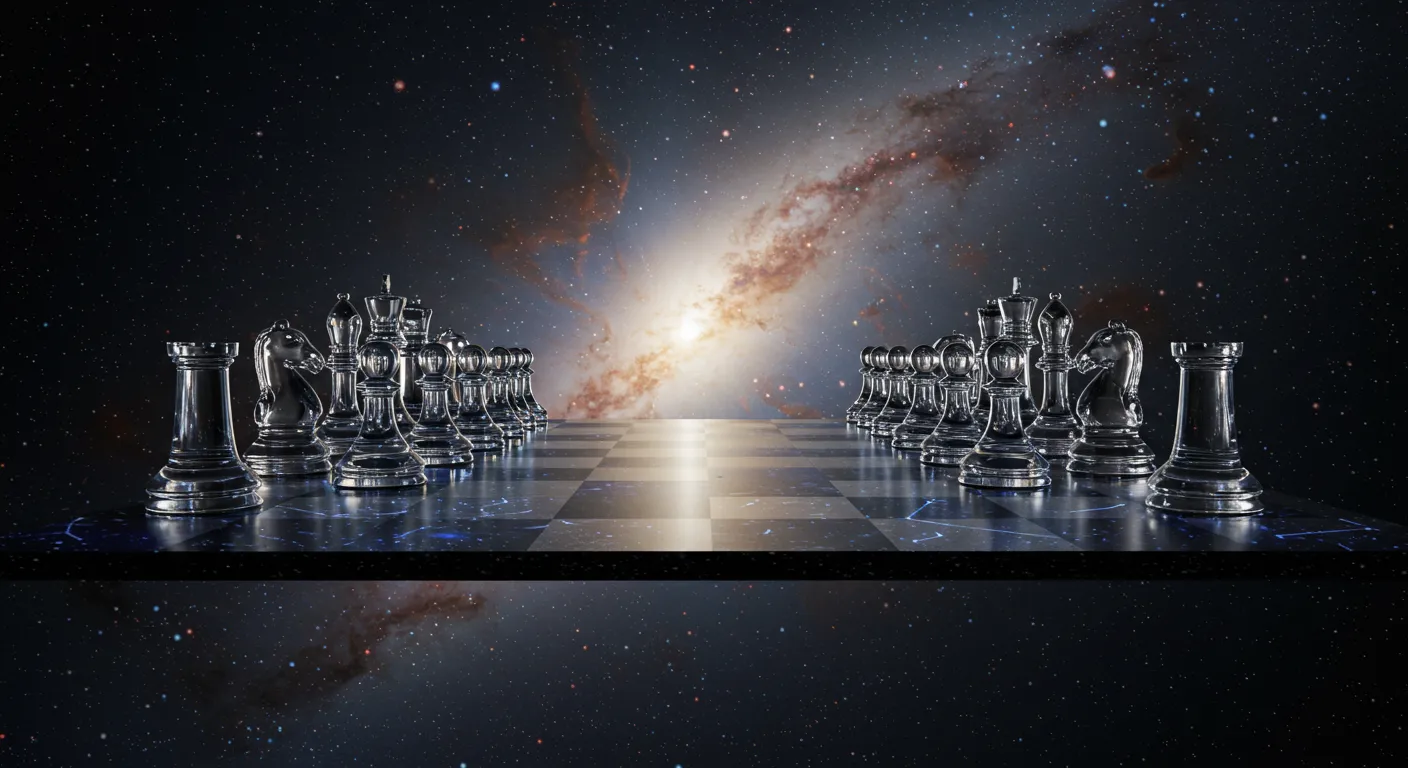
Chess Initiation: Moves and Game Essence
Clear guide on fundamental elements: board, pieces, and basic rules.
Welcome to chess, a game that unfolds a universe of strategy and reflection. This guide has been conceived to offer you a clear understanding of its fundamental elements: the board, the pieces, and the rules that begin the game. Chess is a dialogue between strategy, tactics, and the serene virtue of patience. Let's begin this journey.
The Stage: The Chessboard
Chess is played on a square board, a field of 64 squares (arranged in an 8x8 grid) that alternate light and dark tones, commonly referred to as "white" and "black".
An essential setup rule: at the beginning, each player must have a light-colored square (white) in the bottom right corner of their side of the board.
The horizontal rows are called "ranks" and are identified with numbers from 1 to 8. The vertical rows are the "files", designated by letters, from 'a' to 'h'.
The Actors: The Chess Pieces
Each contender starts the game with a set of 16 pieces, each with its particular character and movement:
1 King: The cardinal piece. Its safety is the axis of the game. If the King is threatened with capture without possible escape (checkmate), the game ends. Its movement is a single square, in any direction: horizontal, vertical, or diagonal.
1 Queen: The most powerful and mobile piece. It moves any number of available squares in a straight line, horizontal, vertical, or diagonal.
2 Rooks: Guardians of straight lines. They move any number of squares horizontally or vertically, along ranks and files.
2 Bishops: Masters of the diagonals. They slide any number of squares across diagonals. Each player has one bishop for white squares and another for black, never changing color.
2 Knights: The most unique movement. They move in an "L": two squares in one direction (horizontal or vertical), then one square at a right angle. The knight can jump over other pieces.
8 Pawns: The infantry of chess. Most numerous, their movement is restricted. Pawns move one square forward along their file, but on their first move, can advance one or two squares. Pawns capture diagonally, one square forward, left or right. If a pawn reaches the opponent's back rank, it is promoted to a Queen, Rook, Bishop, or Knight.
The Purpose: Objective of the Game
The ultimate goal in chess is to achieve "checkmate" on the opponent's King. This happens when the King is under direct threat of capture (in "check") and has no legal move to evade the threat.
Singular Maneuvers: Special Moves
Castling
A special maneuver involving the King and one Rook. The only move where two pieces move at once, and the King moves two squares. There are two types: kingside and queenside castling. All the following conditions must be met:
- Neither the King nor the Rook has moved before.
- All squares between the King and Rook are unoccupied.
- The King is not in check.
- None of the squares the King passes through or lands on are under attack.
En Passant Capture
A pawn can capture an enemy pawn that has just moved two squares from its starting position and lands next to it, as if it had moved only one. The capture must be done immediately.
Outcomes: End of the Game
A chess game can end in various ways:
Checkmate: Victory by checkmating the opposing King.
Draw (Tie): The game ends without a winner. This can happen for several reasons:
- Mutual agreement.
- Stalemate (King not in check, but no legal move for any piece).
- Threefold repetition of the same position.
- Fifty-move rule (fifty moves by each player without any capture or pawn movement).
- Insufficient material to force checkmate.
Resignation: A player can resign at any time.
This guide offers you the foundations. Chess, in its essence, is a game of depth that invites constant exploration. Enjoy the learning process and every game.