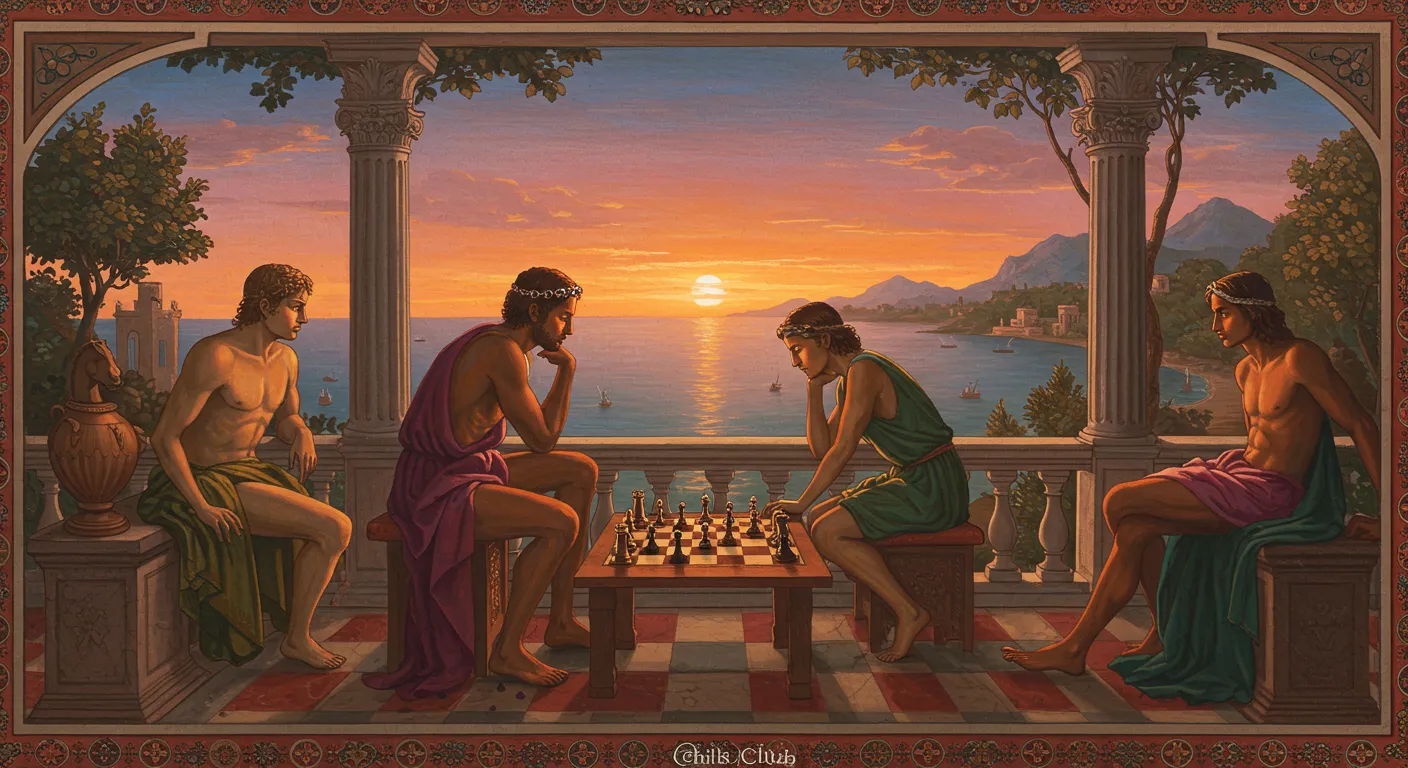
Chess Echoes: A Chronicle of Chess and its Human Soul
Sixty-four squares: an ancient mirror where strategy and passion intersect, reflecting the adventure of the human intellect. A story that, like the game itself, always continues.
There are games designed for momentary oblivion, ephemeral distractions. Chess stands in another category.
A creation of astonishing tenacity: a board, carved pieces, and a set of rules that has fueled an intellectual – and very human – obsession for over a thousand years.
To wonder how this seemingly simple creation has managed to captivate the imagination of entire civilizations, whispering secrets to kings and commoners, to sages and those who flirt with madness, is to open a door to a mystery with many answers. It rather resembles a complex and nuanced position, whose truths are revealed layer by layer, often with austere logic, and sometimes, with a paradox that provokes a knowing smile.
Ancient Origins: From Chaturanga to Persian Refinement
The firmest trace of its origins leads us to India, around the 6th century. In that crucible of cultures, chaturanga was born, conceived as a symbolic reflection of war: infantry, cavalry, elephants (precursors to the current bishops, with a rather clumsy movement for what is expected of a pachyderm in battle) and chariots, all under the command of a Rajah.
It was, in essence, a mirror of society and its conflicts, a small world where strategy began to separate from pure chance – although some scholars, with that characteristic mischief of the historian who enjoys unearthing inconvenient details, suggest the influence of dice in its beginnings, perhaps so the gods also had a say in the outcome.
It is inevitable to imagine those first strategists, frowning, seeing in each move not only a tactic, but the echo of their deep vital tensions, an early manifestation of human will in its eternal struggle to find an order, however fragile, in the face of immense uncertainty.
From India, the game undertook a silent but unstoppable conquest, slipped along caravan routes, was whispered in bazaars, and finally took root in Persia, where it was embraced with the fervor that the Persian soul reserves for poetry and beauty. There it was renamed Shatranj.
It was in this new home that the element of chance began to disappear, allowing skill, foresight, and calculation to become the true judges of the game. The "Shah" (King) and his inevitable end, the "Shah Mat" (the king has fallen), became the axes of this intellectual drama.
In the rich crucible of Sasanian Persia, and under Islamic civilization, Shatranj rose to the status of a mental discipline, almost an austere art. Figures like As-Suli, whose name became synonymous with remarkable mastery, emerged as examples of dedication bordering on obsession. One can almost imagine them, in moonlit courtyards, engrossed for hours in the analysis of a single position, lives symbolically suspended in the balance of a few pieces, an intensity bordering on the sublime.
Expansion to the West and the Queen's Revolution
The wave of Arab expansion brought Shatranj to Europe. Through the Iberian Peninsula, Sicily, and northward, the game spread with the force of pollen in spring. Even the Vikings seem to have succumbed to its appeal on long voyages.
In medieval Europe, chess adapted to a new cultural context. The most radical change was the empowerment of the Queen. The ancient Firzan, a counselor of modest movement, evolved into the most dynamic and lethal piece on the board: "the enraged lady." This revolution added tactical complexity and catapulted chess into a new era. It is an irony that, in rigidly patriarchal societies, the female figure on the board acquired such power.
The Intellect at Play: Renaissance, Enlightenment, and Romanticism
With the Renaissance and Enlightenment, chess became an intellectual exercise. The first treatises appeared, attempts to systematize its study. Figures like Ruy López de Segura not only played but investigated, searching for patterns and principles.
The 19th century brought the Romantic era, a time of bold play and gambits offered with theatrical disdain. Names like Anderssen and Paul Morphy symbolize this audacious spirit. Morphy, a prodigy, dazzled Europe with clarity and strength that shone briefly, reminding us of pressures and loneliness often enveloping exceptional talent.
Towards Modern Understanding: Positional Science and Titan Duels
Play style shifted toward scientific conception. Wilhelm Steinitz, the first world champion, promoted positional strategy and defensive solidity. Champions like Emanuel Lasker, Capablanca, Alekhine, and Botvinnik deepened the legacy, turning world championship struggles into sagas of psychological and intellectual charge.
Chess in Modern Times: Geopolitics and Digital Revolution
The Cold War cast its shadow, Soviet dominance symbolizing intellectual superiority, and the challenges from the West—especially Bobby Fischer—had political symbolism. Fischer's victory in 1972 was a cultural phenomenon, the lone genius against the system.
Today, digital technology has irreversibly changed chess. Analysis engines surpass human capacity. Competing globally is democratized—something Morphy or Capablanca would never have dreamed of. Yet, the unique value of human decision-making, intuition, and imperfection remains.
Epilogue: The Board as an Eternal Mirror
Chess remains a faithful reflection of the human condition: logic and passion, strategy and error, a confrontation with uncertainty. Each game is an affirmation of will, a small drama in 64 squares. The endless story of chess continues as long as two souls sit before the board to undertake this silent dialogue of intellects.